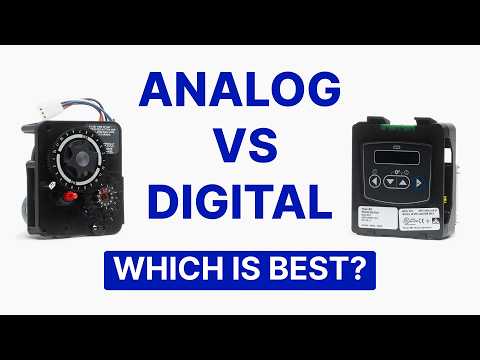
Analog vs Digital: Which Timer Is Best For Your Water Filter or Softener?
When you order a control head, you get asked what kind of interface you want: analog, NXT, or NXT 2. Kevin from Crystal Quest walks through how the three differ in setup, capability, and control so you can pick the one that fits how you want to run your system.
Why the Interface Choice Matters
The control head interface decides how you set backwash timing, how much visibility you have into the system, and how much room you have to grow into advanced features. Each step up the interface ladder gains you more control over your settings and your system as a whole, at a higher price point, so the right choice depends on how hands-on and how capable you need it to be.
Analog (Pin-Set) Timer
The analog timer is also called a pin-set timer because you set the backwash time using pins on a back dial. Each pin represents two minutes, and you add or remove pins by hand to change the cycle length. Changing what time the system backwashes is also done manually on the front interface. It is a good option if you want something more cost-effective, though it is not as simple to set up as a digital timer.
NXT Timer
The NXT expands on the analog timer. You can hook up a flow meter to regenerate based on gallon capacity, connect to building management systems or PLCs, and see far more inside the system, including system status and remaining capacity. The NXT is a good fit if you want versatility with a simple display.
NXT 2 Timer
The NXT 2 does everything the NXT does, such as alternating systems and a standby tank, and adds more advanced communication on top. That enables features like parallel flow sharing, better staging, and smoother regeneration transitions. At a higher price point, it is the right choice for someone trying to get the most out of their system in terms of efficiency and control.
Transcript
Read the video transcript
Transcript
Read the video transcript
Hey everyone. Today, we're going to be talking about the differences between your mechanical, your NXT, and your NXT 2 timers. Hey everyone, it's Kevin from Crystal Quest. When buying your control head, you might get asked a question, what kind of interface would you like? Whether you want an analog, an NXT, or an NXT 2.
What's the difference between these? And why would you pick one over the other? Let's get into it, starting with your analog. We also call it a pin set timer.
We call it this because you set the backwash time based on these pins on your back dial. Each one of these pins represents 2 minutes. And if you want to change your backwash time, you'd either have to manually add or remove one of these pins from the back dial. Also, if you want to change what time your system goes through a backwash, you'll have to manually change that on this front interface.
This is a good option if you're looking for something a little more cost-effective, but it might not be as simple to set up as one of our digital timers might be. Now, let's look at our NXT. With our NXT, we have expanded capabilities compared to our analog timer. With this, we have the option to hook up a flow meter if we want to regenerate based on a gallon capacity.
We have the option to hook it to building management systems or PLCs. And we also have a lot more visibility inside of the system, like system status and remaining capacities. Your NXT is a good option if you're looking for versatility and a simple display. Lastly, let's talk about our NXT 2.
Our NXT 2 can do everything that our NXT can do, like alternating systems and having a standby tank. But, with your NXT 2, you also get more advanced communication. So, you can also have things like parallel flow sharing and better staging and smoother regeneration transitions and so on. Every option you go up with your interface will gain you more control over your settings, your control head, and your system as a whole.
At a bit of a higher price point, this is a good option for someone who's trying to get the most out of their system when it comes to efficiency and control. If you want to know more about each of these interfaces, keep an eye out for their individual videos. And if you have any questions, feel free to leave a comment below, call us, or visit our website at crystalquest.com. Thank you.