What Is Reverse Osmosis? How RO Water Filtration Works (Types, Cost & Maintenance)
Reverse osmosis is on every water filter ad, every bottled water label, and more and more of the home improvement aisle, yet most people do not actually know what it is. This explainer breaks down how RO works, the difference between point-of-use and whole house systems, the three membrane types, and the wastewater, maintenance, and cost factors to weigh before you buy.
Why Understanding RO Before You Buy Matters
Reverse osmosis is one water treatment option to compare with your needs, including its wastewater and maintenance requirements. Crystal Quest believes you should know everything there is to know so you can decide what is genuinely right for your situation rather than reacting to marketing.
What Is Reverse Osmosis?
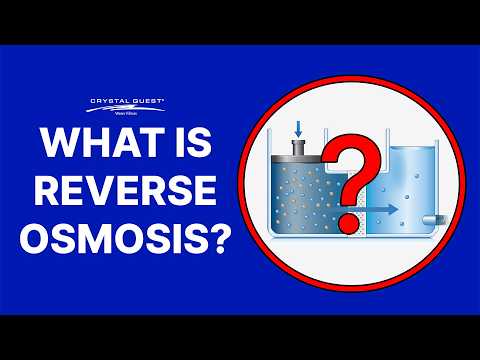
In simple terms, reverse osmosis is a water purification process where water is forced through very small holes called pores under high pressure. To put it in perspective, RO pores measure about 0.0001 micron, roughly 700,000 times smaller than a human hair. The membrane separates treated water from a concentrate stream. The video discusses dissolved solids and other contaminants in explaining that separation.
Point-of-Use vs Whole House RO
There are two broad categories of RO systems. Point-of-use systems are the most common: small, compact, efficient units typically found in the kitchen, under the sink, or on a counter. Point-of-entry (whole house) systems are the large systems that sit at the main water line coming into your home and filter the water for every tap, spout, and spigot.
The Three RO Membrane Types
Point-of-entry systems use one of three membrane types, generally chosen by your incoming TDS (total dissolved solids). A freshwater membrane suits low to moderate TDS, a brackish water membrane suits moderate to moderately high TDS, and a desal membrane is for high or extremely high TDS. Matching the membrane to your water is what keeps the system efficient.
Why You Would Want an RO System
A point-of-entry RO treats water at the incoming household water line. The video compares this whole house approach with treatment at a single point of use. A point-of-use RO can make sense if you want something more cost-efficient than a whole house system, if you already have a whole house filter and want an added layer of protection, or if you simply want peace of mind at the kitchen tap.
Considerations: Wastewater, Maintenance, and Cost
Bottled-water quality straight from the sink sounds great, but there are trade-offs. RO systems produce wastewater: for every gallon of pure water made, some amount goes to drain, and the ratio varies by system. They also carry more maintenance than a standard media- or cartridge-based system because there are more moving parts like pumps and motors, and consumables such as membranes cost more than cartridges. Taken together, these raise the cost of ownership over the long run.
Increased Water Use
The wastewater factor surprises people most. Because every gallon of pure water comes with some wastewater, your overall water usage goes up, especially with a whole house system where all your water passes through it. You could see roughly a two-to-three-times increase in water usage to get the same amount of finished water. Knowing this up front is exactly the kind of information that lets you make an informed decision.
Transcript
Read the video transcript
Transcript
Read the video transcript
Reverse osmosis, it's on every water filter ad, every label of bottled water, and more and more down every aisle of a home improvement store. But, most people don't actually know what reverse osmosis is. Today, we're going to get into all the details, whether you're looking to buy or just learn more about reverse osmosis. So, first, let's understand what reverse osmosis is.
In simple terms, it's a water purification process where water is forced through very small holes called pores with high pressure. To put in perspective, RO pores are 0.0001 micron. That's 700,000 times smaller than a human hair. Because of the size of the pores, the only thing that can physically pass through is pure H2O.
That means your PFAs, your TDS, your dissolved salts, anything you wouldn't want to drink gets left behind. You could think of this like a really small net catching all the contaminants and letting pure water pass through. Now that we know what reverse osmosis is, let's get into the types of systems you'll see on the market. You've got two types, your point of entry systems and your point of use systems.
Point of use systems are most commonly what you're going to see. These are small, compact, and efficient RO systems that are typically found in places like your kitchen, under the sink, on a counter. Then, you've got your point of entry systems. These are the big systems that sit at the main water line coming into your house.
These filter the water for every tap, every spout, spigot in your home. It's important to know that with these point of entry systems, you've also got three different types of membranes to pick from. One, your freshwater membrane, two, your brackish water membrane, and three, your desal membrane. Without going too much into detail in this video, these are generally going to be chosen based on your incoming TDS or total dissolved solids.
So, low to moderate, you pick freshwater. Moderate to moderately high, you'd pick brackish. And high or extremely high, you would go with desal. If you guys are interested in learning more about each of these membrane types, please leave a comment.
We're more than happy to put together a video so that you can figure out which membrane is best suited for you. So now we get to the why of everything. You know what it does, you know the different types, but why would you need one or why would you want one? Well, there's a couple reasons.
It can really be a nuanced answer, but without getting too much into it, we'll cover generally why. First, why would you want a point of entry RO? Well, you might want complete control over your water quality. You're never going to get water quality that is equivalent to bottled water without an RO system.
You might want to remove everything from your water and have a blank slate to work with. And point of entry systems let you do this at scale for your entire home. Another reason why you might want or even need a whole house RO system really comes down to water quality. Maybe your water quality is so poor that you really need something as robust and as comprehensive as an RO system.
In the case of point of use systems, you could want one of these for a number of reasons. Maybe you're looking for something a little bit more cost-efficient than a whole house system. Maybe you already have a whole house filter and you're looking for an added layer protection. Maybe you just want some peace of mind.
The number of reasons could go on, but before you go and buy one, there's some things to consider. Bottled water quality straight from your sink sounds amazing, but we need to consider a few things first. One that often gets overlooked is waste water. RO systems produce waste water.
That means every gallon of water that you make is pure, you're going to have some amount of waste water. The amount can vary depending on the system setup, but something to consider. The other thing is general maintenance. These systems naturally are going to have more upkeep than a standard media-based or cartridge-based system just because there's more moving parts.
You got pumps, motors, things like that. Because of the general maintenance, you might also have to replace some parts. This ties into general cost. These systems may cost more to own and operate and keep in good condition compared to a standard system.
You've got consumables that are going to cost more naturally. Your membranes are going to be more expensive than cartridges. These systems can be equipped with a number of cartridges, a number of membranes. This is just something you have to consider when you're thinking about the cost of ownership over a long period of time.
One thing that can catch people off guard is the cost of the waste water. Like I said earlier, for every 1 gallon of pure water these produce, there's some amount of waste water. This is going to raise your overall water usage, especially in the case of a whole house system, where all the water's filtering through this one system. You could expect maybe a two, three time increase in water usage just to get the same amount.
This is something we've actually seen people personally surprised by. Real life experience, where they don't expect their water usage to go up, they don't know anything about waste water, maybe no one mentioned it to them. That's why we want to be here to tell you, so that when you're buying a system, or if you're just learning, you're equipped with all the information that you need to make an informed decision.
At Crystal Quest, we believe that you guys should know everything there is to know to be able to determine what's best for you. RO can get quite expensive. We tried our best to really condense it down into a format where it could be easily digested and understood, giving you the information you need to make informed decisions. But, if you ever have any questions, feel free to leave us a comment, visit our website, or call us.
We're more than happy to talk your ear off about anything water related. I hope you enjoyed this video, and until the next one, we'll see you guys.