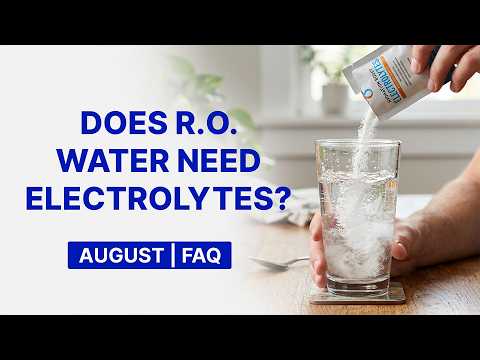
Does RO Water Need Electrolytes? Water Filtration Q&A (August)
This August Q&A covers RO water and electrolytes, a pitcher owner's TDS question, apartment water treatment, and how different treatment technologies fit together.
In This Video
The questions show why the measurement, treatment goal, and installation setting need to be considered together.
RO Water and Electrolytes
AJ discusses the question of adding electrolytes to RO water and distinguishes remineralization preferences from how the RO system works.
What a TDS Meter Measures
A TDS reading does not describe every contaminant or every filter's performance. The discussion explains why a pitcher can be working without producing the TDS reduction expected from RO.
Water Treatment in an Apartment
The video considers shower filtration and water softening as different approaches, and discusses the installation limits that may come with renting.
Matching Treatment to Different Contaminants
AJ explains why one blanket promise to remove everything without affecting pressure is not an appropriate way to select a system. The treatment approach needs to follow the water and the application.
Upflow, Downflow, and Pretreatment
The closing discussion compares flow direction and discusses how the position of pretreatment relates to the rest of a system.
Frequently Asked Questions
Does an unchanged TDS reading prove a pitcher filter has failed?
No. The video explains that a pitcher's treatment goal differs from RO, and TDS alone does not measure all of its filtration functions.
Can one system remove everything with no effect on pressure?
AJ does not make that promise. The video discusses matching different technologies to the contaminants and the water demand.
Keep Learning
Transcript
Read the video transcript
Transcript
Read the video transcript
Hey guys, it's AJ. We're back again for Q&A for the month of August. We've got some good questions that we've curated. Let's go ahead and jump right into it. The first question that we've got here is, "Does reverse osmosis water need added electrolytes for proper hydration?" No.
For most people on a healthy normal diet, you do not need to re-add electrolytes back into the water. The RO system is going to remove TDS and it might strip it down very low, but that probably isn't something you need to add electrolytes back into. You'll still be able to get proper hydration because you're drinking water, but if you want to, there's no harm in adding electrolytes back in, maybe flavor or beneficial minerals. Really what you might want to add back in is actually something like calcium or magnesium to add a little bit of alkalinity, but in terms of hydration and electrolytes, you probably don't need to add any more. "Hello, I'm not sure what my order number was .... Maybe you could look me up by name." We always can look you up by name, so if you ever need to reach out, we can do that. "I bought a water pitcher about 3 months ago.
The filter was supposed to last 6 to 12 months, but I tested the water quality today with a TDS easy meter. Mm. I measured the tap water, refrigerator filter, and pitcher water. There was no difference between the tap and pitcher water quality. See pics below.
Would there be an explanation for that?" There is. "I stopped using it as it's doing nothing for me now, but it should have lasted much longer." "It could have been this quality the whole time I've had it. Please let me know what can be done. Thanks." We've got a common myth right here that TDS is going to be reflective of how well your filter's working. And unless it's like an RO system or some sort of system specifically for TDS, you might not actually see a reduction in TDS. And there's a very good reason and I'm glad that the customer asked.
We have to understand what a TDS meter is measuring and that's the total dissolved solids. So, the TDS is measuring the things that are submerged in the water and with something like a water pitcher, we're not actually focusing on removing TDS. We're focusing on absorbing chemicals to the media. So, this might not mean always pulling things out of the water, but rather it could be exchanging them or binding them. And in some cases, we're changing the composition of the chemical.
So, this might not actually result in a TDS drop. It could be the same, and in some cases, it could actually increase the TDS because we might be adding things or swapping things back in. So, just because you test your TDS and it measures the same or maybe even higher, does not necessarily mean that your filter is not working. We're just measuring the wrong thing. Next, we got a question from a potential customer asking, "I'm in an apartment renting.
What can I use to soften up the water in my apartment where it's not affecting me or my children's skin or hair?" So, from this question, I'm kind of gathering that the children and yourself are probably having drier skin, drier hair. And while this could be hard water, it could also be something like chlorine. So, it wouldn't be a bad idea to consider, like first step, maybe getting a shower filter, see if that helps with the dry skin and drier frizzy hair. That might give you everything that you need. If it is a case where your water is truly hard and reducing the chlorine isn't helping, while we don't offer a mini uh water softener on the website, we can always do like a custom We can always do like a custom uh water softener setup.
So, this would use like I think a 0.75 cubic foot, but we can adjust sizing and get you something very specific for use if you need it. This would basically go in line right before the shower if something like a whole house softener is not an option or a shower filter isn't working, this is an alternative that we could maybe explore. So, reach out and we'll see if we can help. So, here we've got someone asking, "What whole house system removes everything including pharmaceuticals, pesticides, fluorides, metals, bacteria, and chemicals without losing pressure?" This is a loaded question and as much as I love to say that there's one system that can do all of these things and lose no pressure, I can't actually say that um because honestly no system like that exists. It would be great if it did.
Basically everything and actually everything are two different things, and I I say a whole house RO system can remove basically everything for normal application. So, your dissolved solids, your heavy metals, chemicals, all of that. But, the truth is individual technologies are best suited for different things. So, our whole house RO systems come equipped with sediment filters, carbon filters, the RO membrane, of course, uh which will remove sediment, chemicals, pharmaceuticals, organic contaminants, as well as all the dissolved solids. But, for something like bacteria, no filter is really going to touch that other than a like a UV sterilizer.
So, in this case, it would be best to get a whole house RO system with a UV sterilizer, and we have to accept that there's going to be a little bit of pressure drop. So, whenever we're thinking about distance of water traveling, as well as a system actually needing to filter the water, there's going to be a minor drop. Uh there's no way around losing pressure with a water filtration system, but if you size it correctly, then we can reduce that to a minimal pressure drop. What is the difference between upflow and downflow filtration, and should chlorine be dosed before or after treatment? And they're asking in the context of a metal removal system, as well as I think a tannin removal system.
So, with an upflow system, water is going to enter the tank from the top. It's going to flow through an upper basket, down the riser into the middle of the system, and then it's going to swirl back up and through the outlet. The downflow system is going to be coming in from the top of the distributor, going through a basket, essentially, through the system, and then back up the riser tube, and through the outlet. So, with an upflow system, you will not need to backwash, and this is usually pretty pretty straightforward because it's fluffing up the media. So, that's the difference between upflow and downflow.
The question about chlorination going before or after is very important in uh an iron removal system context, but in general, you typically want to have the dosing solutions before any filtration. This is going to act as a pretreatment stage. So, in this case, chlorinate the water, oxidize the iron before the iron removal system, and then filter it through the house. This could apply to like a silica dosing, chlorine dosing, anti-scale, anything like that. So, pre-dosing usually goes first for that reason.
You want to filter before the filter. And those are the questions and answers that we had for the month of August. If you guys enjoyed the questions and learning about water filtration, go ahead and leave a like, drop a comment if you have a question and we'll pull it into the next video. And if you want to read more about upflow versus downflow, check out the article in the description below. We will see you guys next month.
Until then, goodbye. That was so bad. Oh my god. I don't know what to do, dude. I never know how to close it.
Do I just say goodbye? Like