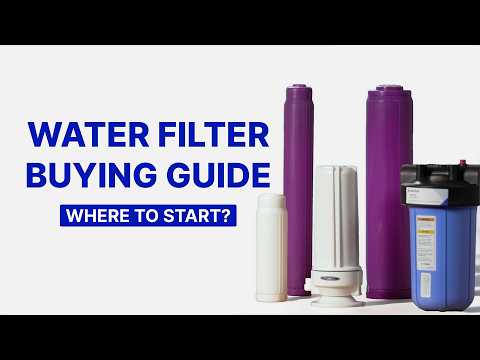
How to Choose a Water Filter System: A Step-by-Step Beginner's Guide
This beginner's guide turns a broad water filtration decision into a sequence: understand the water, match the technology, choose the format, and review the provider.
In This Video
A system choice starts with what is in the water and where treatment is needed. Household demand becomes part of the decision when the system serves the whole home.
Match the Contaminants to a Technology
Start with the contaminants in the water, then identify the treatment technology suited to them. The video gives hardness and softening as one example.
Choose Point of Use or Point of Entry
Decide whether you want treatment at one location or at the incoming household water line. The video compares under-sink, countertop, pitcher, shower, and whole house formats.
Consider Whole House Demand
For whole house systems, consider occupancy, bathrooms, simultaneous use, flow, contact time, and pressure. Peak use matters when comparing a system with the home's requirements.
Compare Providers and Information
The video recommends examining company history, transparency, independent reviews, and information about the parts and filtration media.
Frequently Asked Questions
What is the first step in choosing a filter?
The video starts with matching the contaminants in your water to the appropriate treatment technology.
What is the difference between point of use and point of entry?
Point of use treats water at a particular location. Point of entry treats water at the incoming household water line.
Why does peak water use matter?
A whole house system must be considered against the demand when several fixtures or appliances run together.
Keep Learning
Transcript
Read the video transcript
Transcript
Read the video transcript
This transcript includes marked editorial notes.
If you're just getting into the water filtration space, or you're looking to buy a system, you're seeing a lot of language that you might not fully understand. You're not sure where to start, you don't know what you don't know, and you don't know how to begin. The point of this video is to help make that path clear, give you an actionable plan so that you can figure out what exactly you need and what do you need it for. Well, the good news is this is a simple step. All you're really doing in essence is matching.
You're finding which contaminants you have and which technology is best suited for those contaminants. To simplify this a little bit more, if you have high hardness, you're going to opt for something like a water softener. If you have fluoride, you might opt for activated alumina. This is where it really helps to have a base understanding of the different technologies in water filtration and what they're used for. It's also a great opportunity to make sure that you're not being upsold on something that you don't necessarily need.
And assuming your water isn't super complex and there's no very specific needs, it's probably something that you can do on your own. So at this point, we've identified the contaminants in our water and hopefully we've selected the correct technology for our contaminants. Now we're going to decide format and size. When I say format, I'm talking about point of use and point of entry systems. This is the difference between a whole house system and an under sink or counter top or even a pitcher.
And I would suggest that you ask yourself, what do I want? What do I prefer? Am I looking for something to filter every faucet in my home, or do I just want something in the kitchen, or on the shower, or on my counter top? If you've opted for a point of use system, your options are basically counter top, under sink, pitcher, shower filter, or any other inline filter. Now we just need to think about, do we want it hidden away under a sink, or do we mind if it's on a counter or on the shower?
Once that decision's been made, you can consider it done. You found the system that you needed, it's properly selected for the contaminants that you need removed, and it's basically a win at this point. There's not as many factors to consider when comparing it to a point of entry system. With a point of entry system, we need to think about the amount of people in the home, peak water usage, flow rates, contact time, as well as water pressure. This might sound a little daunting, but it's not as complex as it sounds.
This is a good checkpoint to ask yourself a few questions. How many people are in your home? How many bathrooms do you have? How many showers might be running at once with a dishwasher or a washing machine? We need to consider if maximum amount of water was being used at once, what would that look like?
This would mean, for example, in a house of five, you would need a bit of a larger system compared to someone in a home of two. These questions and answers have influence on the design of the system. If you have a larger home, you may need a media-based system rather than a cartridge-based system, just to support peak water usage. In most cases, product listings will list the gallons per minute, as well as recommended household occupancy for these systems. Once we've narrowed it down to a system that meets your water demands, we can basically consider it done.
You've got a properly-sized system best suited for the contaminants you need removed. At this point, we've identified contaminants, we've chosen a technology, and we've chosen a format. We chose point of use if we wanted something a little bit more compact at a specific place, like your under-sink or countertop, or we've chosen a point of entry system if we want whole home filtration, considering peak water usage, occupancy, and flow rates. That's great. We know exactly the system we want, but the next big question is, who do I buy it from?
Of course, we'd love if you purchased it from us, but there are a lot of options out there. How do you find a good company with a good system? There's a few things to look out for. You want to look for a company that's well-trusted, a company that's been around for years, decades even. You want to look for companies that are transparent, tell you everything you need to know.
You want to look at some reviews of the companies, see what other people are saying about the company. When you're looking at reviews, make sure they're not curated. Make sure they're real people talking about their experiences. These are all things you want to look at to create a profile about the company and make sure that you actually trust them. The most important thing in water filtration is trust.
You want to know that the company and the people you're dealing with have your best interest in mind. They're not trying to make an extra dollar, they're trying to make sure that you get proper filtered water. Another thing to consider are the parts and components that these companies use. [Editorial note: The general system certification discussion is omitted. NSF/ANSI references apply to parts or components, not Crystal Quest company or product certification.] I hope all this helped. Hopefully, it cut through the noise a little bit more and made this a little bit more simple.
If you're still unsure where to go from here or you just don't want to go through the process alone, we're always here to help. We'll ask questions and determine exactly what you need. If you have questions regarding the video or need clarification on anything else, please leave us a comment, send us an email, give us a call, or go to our website at crystalquest.com. We're more than happy to answer any questions you have.