Reverse Osmosis EXPLAINED
Reverse osmosis is everywhere: on filter ads, bottled water labels, and store shelves, but most people do not know what it actually is. This short explains it in seconds: a treatment process that forces water through a membrane and separates treated water from a concentrate stream.
Why RO Is Worth Understanding
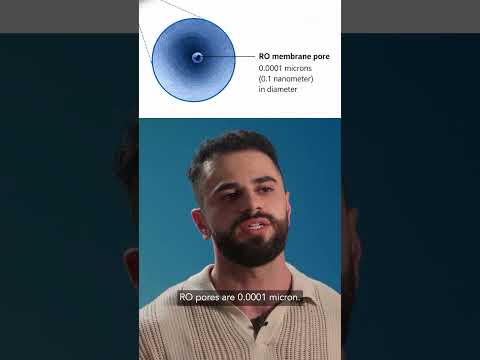
The term reverse osmosis is often used without explaining the treatment process. Knowing how it works, with water forced through pores about 0.0001 micron, roughly 700,000 times smaller than a human hair, makes it clear why RO can leave behind PFAS, TDS, and dissolved salts that other filters miss.
Keep Learning
Transcript
Read the video transcript
Transcript
Read the video transcript
Reverse osmosis. It's on every water filter ad, every label of bottled water, and more and more down every aisle of a home improvement store. But, most people don't actually know what reverse osmosis is. In simple terms, it's a water purification process where water is forced through very small holes called pores with high pressure.
To put in perspective, RO pores are .0001 micron. That's 700,000 times smaller than a human hair. Because of the size of the pores, the only thing that can physically pass through is pure H2O. That means your PFAs, your TDS, your dissolved salts, anything you wouldn't want to drink gets left behind.
You could think of this like a really small net catching all the contaminants and letting pure water pass through.